
Sometime in your 40s, you may notice that your phone, menus, or books seem easier to read when you hold them farther away. This age-related change in near focusing is called presbyopia. If you already wear contact lenses for distance, one solution is to put reading glasses over your contacts whenever you need to see up close. But if you'd rather reduce your dependence on readers, multifocal contact lenses may be an option.
Multifocal contact lenses incorporate more than one optical power into the same lens, allowing you to see across multiple distances without constantly switching between contact lenses and reading glasses. The interesting part is how they accomplish it.
What Is Presbyopia?
Presbyopia is the gradual age-related loss of the eye's ability to focus on nearby objects. When we're younger, the natural lens inside the eye changes shape to adjust focus between distant and nearby objects. This process is called accommodation. As we age, the lens and accommodative system become progressively less flexible, reducing the eye's ability to focus at near.
Most people begin noticing the effects sometime in their 40s.
Presbyopia is not an eye disease. It's a normal age-related change, and it eventually affects everyone.
What Is a Multifocal Contact Lens?
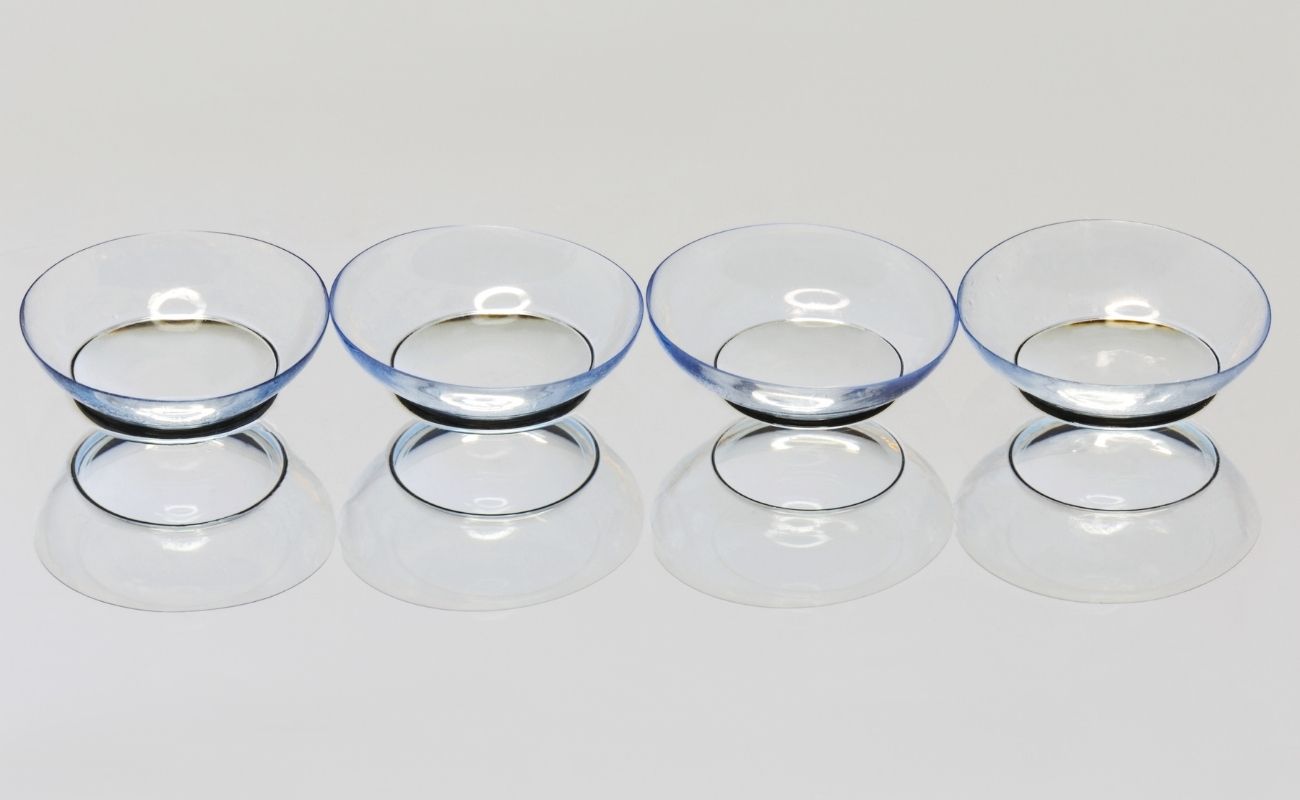
A multifocal contact lens contains optical powers designed to provide useful vision at more than one distance.
Depending on the lens design, these powers may provide vision for:
- Distance
- Intermediate tasks such as computer work
- Near tasks such as reading or using a phone
Unlike progressive eyeglasses, you generally don't have to deliberately look through a particular part of a soft multifocal contact lens. The contact lens moves with the eye, and its optics are designed to provide visual information from different focal distances through the pupil.
How Do Multifocal Contact Lenses Actually Work?
Most modern soft multifocal contact lenses use what's called simultaneous vision. Different optical powers are incorporated into different areas of the lens. This allows light associated with more than one focal distance to enter the eye at the same time.
Your visual system then learns to process and prioritize the visual information that is most useful for the object you're trying to see. Think about having a conversation in a busy restaurant. Your ears receive sound from multiple conversations, music, dishes, and background noise, but your brain can concentrate on the person speaking to you. Multifocal vision works somewhat similarly. Your visual system receives optical information corresponding to multiple focal distances and adapts to use the information needed for the task.
This process is one reason multifocal contact lenses may feel different initially and why some patients require an adaptation period.
The Main Multifocal Contact Lens Designs
There isn't one universal multifocal design. Different manufacturers and custom lens laboratories use different optical strategies, and one design may work significantly better for a particular patient than another.
Aspheric Multifocal Lenses
Many soft multifocal contact lenses use an aspheric design in which optical power changes gradually from the center toward the periphery of the lens.
Depending on the design, the center may emphasize near vision or distance vision. These are often described as center-near or center-distance designs. Because the optics are distributed across different portions of the lens, factors such as pupil size, lens centration, and lighting conditions can influence visual performance.
Concentric or Annular Multifocal Lenses
Concentric multifocals incorporate different optical zones arranged in rings around the center of the lens. These zones provide different powers for near and distance vision. Again, the goal is simultaneous vision rather than having the patient deliberately look through a specific ring.
Translating or Alternating-Vision Designs
Some rigid gas permeable multifocal or bifocal contact lenses use a translating design.These lenses function somewhat more like bifocal eyeglasses. Lens positioning and movement allow the patient to access different optical portions of the lens depending on gaze. These designs require precise fitting and are primarily associated with rigid lens designs rather than conventional soft multifocal lenses.
Toric Multifocal Contact Lenses
Patients with astigmatism can also wear multifocal contact lenses.Toric multifocal lenses combine astigmatism correction with multiple powers for presbyopia. Options include commercially available soft toric multifocals as well as highly customized soft, corneal GP, and scleral multifocal designs for patients with more complex prescriptions or visual requirements.
Multifocal Contacts vs. Monovision
Multifocal contact lenses aren't the only way to correct presbyopia with contacts.Another option is monovision. With monovision, one eye is generally corrected primarily for distance while the other is corrected more for near. The visual system learns to use information from the appropriate eye depending on the task.
Multifocal lenses take a different approach by providing multiple focal powers to each eye. There are advantages and compromises with both approaches. Multifocal contact lenses may preserve binocular visual function and stereopsis better for some patients because both eyes continue to participate across distances.
Monovision can provide excellent functional vision for other patients, but increasing the difference between the two eyes may reduce stereopsis or binocular performance.Some patients also do best with a modified monovision approach, for example, multifocal lenses in both eyes with one eye biased slightly toward distance and the other toward near.
There is no universally “better” option. The best strategy depends on the patient's prescription, visual demands, ocular health, and how the individual visual system responds.
Multifocal Contacts vs. Reading Glasses Over Contacts
The simplest option for a presbyopic contact lens wearer is often to continue wearing distance contacts and use reading glasses when needed. This generally provides excellent distance correction and allows strong near vision when the reading glasses are on. The disadvantage is obvious: you still need to carry and use reading glasses. Multifocal contact lenses are designed to reduce that dependence by providing functional vision across a wider range of distances.
However, there can be a tradeoff. A multifocal lens is trying to provide several focal distances simultaneously. Some patients may notice slightly reduced contrast, halos, or vision that isn't quite as crisp as single-vision correction under certain conditions.
The goal is therefore not necessarily to make every distance identical to single-vision glasses. The goal is to find the best overall balance of distance, intermediate, and near vision for your daily life.
What Should You Expect When You First Wear Multifocal Contacts?
Multifocal lenses can feel visually different from single-vision contacts when you first start wearing them. Some patients adapt very quickly. Others need more time.
During the initial adaptation period, you may notice:
- Slightly softer vision at certain distances
- Halos or glare around lights
- Reduced contrast in dim lighting
- A greater need for good lighting when reading small print
- One distance seeming clearer than another
These symptoms often improve as the visual system adapts and as the prescription and lens design are refined.
Importantly, the first trial lens is not necessarily the final prescription. Multifocal fitting frequently involves adjusting distance power, near addition, lens design, or the balance between the two eyes based on the patient's real-world experience.
Why Is My Near Vision Blurry in Multifocal Contacts?
Blurry near vision doesn't necessarily mean multifocal contact lenses won't work for you. Several factors can affect near performance, including:
- The distance prescription
- Near addition power
- Multifocal design
- Lens centration
- Pupil size
- Lighting
- Tear-film stability
- Ocular-surface health
- The visual demands of the task
The tear film is especially important. A contact lens sits within the tear-film environment, so an unstable ocular surface can make vision fluctuate and reduce the quality of multifocal optics. If dry eye is contributing, optimizing the tear film and ocular surface may significantly improve both comfort and visual performance.
Can You Wear Multifocal Contacts With Astigmatism?
Yes.
Patients with astigmatism have several options depending on the amount and type of astigmatism. Commercially available soft toric multifocal lenses can simultaneously correct astigmatism and presbyopia.
For prescriptions outside standard parameters, custom soft multifocals, multifocal GP lenses, hybrid lenses, or multifocal scleral lenses may provide additional options. This is an area where customized contact lens fitting can make a significant difference.
Can Multifocal Contact Lenses Be Used for Myopia Management in Children?
Yes, but this is a different use of multifocal or dual-focus optics. Certain contact lenses designed for children use specialized multifocal or dual-focus optical designs to help slow the progression of myopia.
These lenses aren't simply adult presbyopia lenses prescribed to children for reading. Myopia-management contact lenses use specific optical designs intended to provide clear central vision while altering peripheral or simultaneous retinal defocus in a way that can reduce the stimulus for continued eye growth. For children with progressive myopia, contact lenses may be one component of a comprehensive myopia management program.
What About Night Driving?
Multifocal contact lenses can be worn for night driving, but visual performance varies between patients and lens designs.Because multifocal optics distribute light across multiple focal powers, some patients notice halos, glare, or reduced contrast, particularly in dim conditions when the pupil becomes larger.
These symptoms may improve with adaptation or changes to the prescription or lens design.
Patients who do a significant amount of nighttime driving should mention this during their fitting so that nighttime visual performance can be prioritized when selecting and adjusting the lenses.
Who Is a Good Candidate for Multifocal Contact Lenses?
Multifocal contacts can be an excellent option for people with presbyopia who want to reduce their dependence on reading glasses. Good candidates are generally willing to accept a brief adaptation period and understand that achieving the best result may require more than one trial lens.
Candidates may include patients with:
- Near-vision difficulty from presbyopia
- Myopia or hyperopia
- Astigmatism
- Previous contact lens experience
- No previous contact lens experience
- Dry eye that can be appropriately treated and optimized
Dry eye doesn't automatically rule someone out. The important thing is to optimize the tear film and ocular surface and then select the lens material, design, and fit that best matches the patient's eyes and visual needs.
Are Multifocal Contact Lenses Right for You?
Successful multifocal contact lens fitting is about finding the right balance. Someone who spends the day working on multiple computer monitors may need a different visual emphasis from someone who drives frequently at night, performs highly detailed near work, or primarily wants to read menus and text messages without glasses.
At Weston Contact Lens Institute, we evaluate your prescription, ocular surface, tear film, pupil characteristics, and visual demands before selecting a multifocal design. Trial lenses allow us to evaluate how you actually see in the real world, and follow-up visits allow us to fine-tune the prescription and lens design. The goal is to give you comfortable, functional vision across the distances that matter most in your everyday life. Contact Weston Contact Lens Institute to schedule a multifocal contact lens evaluation. Patients closer to Miami can also be seen at our Miami office.